




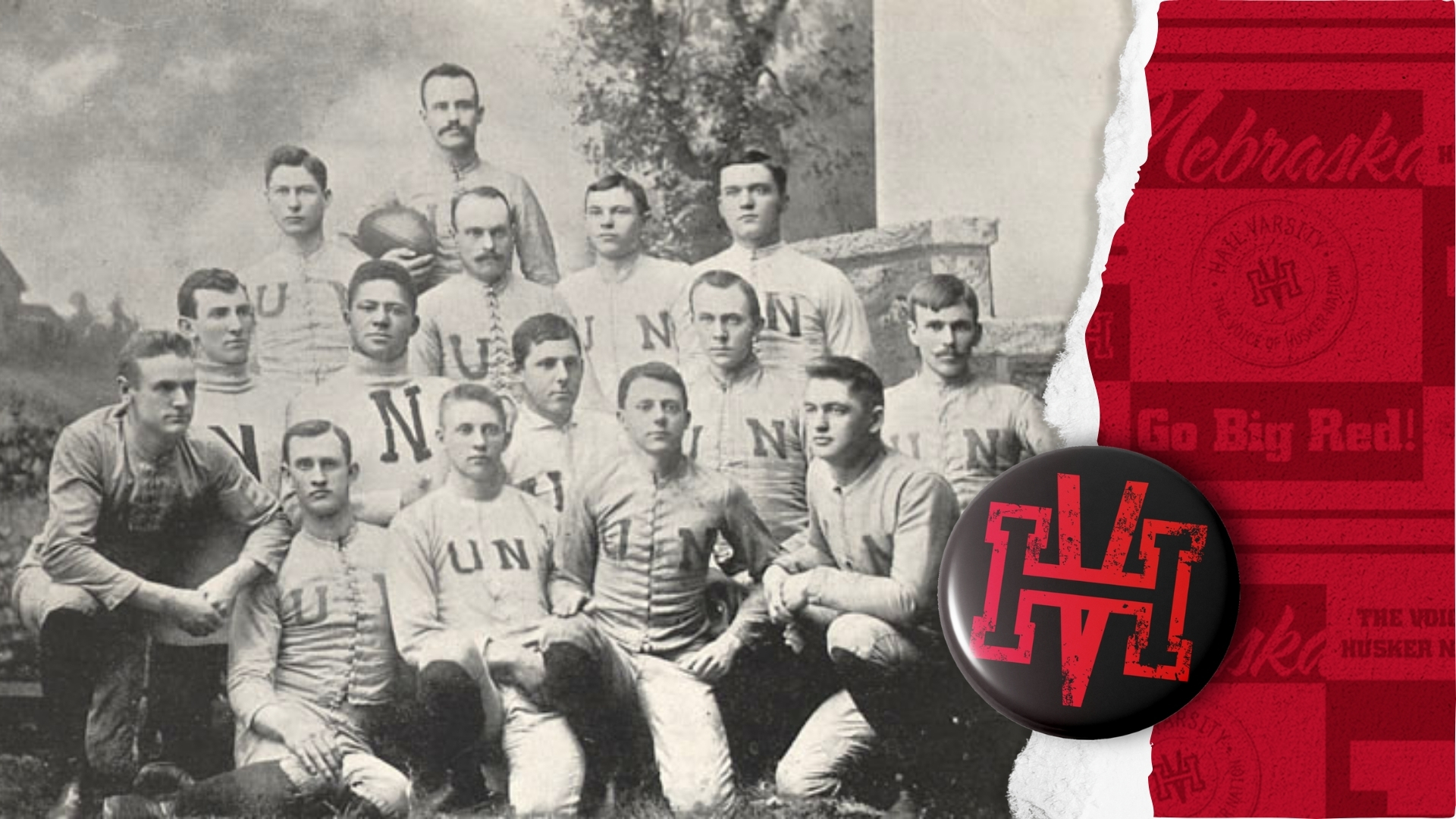
The focus of the next couple Hail Varsity Historical installments will be on other Nebraska football topics rather than past game recaps.
Nebraska football’s oldest rivalry is with Iowa, its first out-of-state opponent. That’s probably appropriate now, given the acknowledgement of the rivalry by the Big Ten. It’s the “Heroes (Trophy) Game.” Nebraska and Iowa have played the final game of the regular season on the Friday after Thanksgiving since the Huskers joined the conference — except in 2020, altered by COVID-19.
Nebraska trails during that time, going 4-11.
Nebraska first played the Omaha YMCA in late November 1890, followed by Doane in mid-February 1891, then Doane twice more in late fall 1891 before the Iowa game on Nov. 26, Thanksgiving, in Omaha. Nebraska was without a “coach” and E.E. Mockett, the captain and leader, had left the team. So T. U. Lyman came in to prepare the team.
“Captain Lyman was the coach of the State University of Iowa team, the Nebraskans’ next opponent!” Frederick Ware wrote in “Fifty Years of Football: A Condensed History of the Game at the University of Nebraska,” published by the Omaha World-Herald in 1940.
Ware was the World-Herald sports editor. His history, in collaboration with staff writer Gregg McBride, is exceptional, but not completely accurate it seems.
“The explanation was simple: Iowa wanted a good contest, and lent its teacher in an effort to ensure it,” Ware continued. His source appeared to be the Lasso, a student publication.
The Daily Nebraska State Journal was on board with the claim about Lyman. At the end of its game story in the next day’s edition it noted: “Coacher (stet) Lyman, of the latter team, will return to Lincoln and give his men further practice for future interstate games.”
However, according to a history of Iowa football, written by Chuck Bright and published in 1982, Lyman played (and “coached”?) at Iowa College in Grinnell, a University of Iowa rival.
Nevertheless, the story of Lyman coming from Iowa to Lincoln to help prepare Nebraska for the 1891 game continued. I wrote about it, even though it seemed odd, based on Nebraska football media guides, which included, under Lyman’s name: “Assisted the NU team in its preparations for its game against Iowa, despite serving as head coach at Iowa at the time. Coached Iowa to a 22-0 victory over NU.”
That changed in 2001 to: “ … despite serving as head coach at a small school in Iowa at the time.” Now the entry includes “head coach at Grinnell College in Iowa.”
The concept of “head coach” apparently often meant “captain.” Lyman, who didn’t return to coach Nebraska, had earned letters in football at Grinnell the three previous seasons.
The Lincoln Daily Call referred to Nebraska as the “Old Gold Knights,” among a handful of nicknames given to Nebraska in the early years of football, the subject of a future Historical. Another future subject will be Black athletes at Nebraska. The first, George Flippin, played in the Iowa game, which drew 2,000 fans according to Bright’s history of Iowa football.
“Flippin is the late addition that the team can congratulate itself upon,” the Lincon Evening Journal noted. “His tackling was superb and merits special mention.”
He was listed as a “half back.”
But he’s a subject for another time, which also includes a change in Nebraska football history. Things such as Lyman’s coaching underscore, what I may have written before, Marcel Proust’s: “Remembrance of things past is not necessarily the remembrance of things as they were.”