




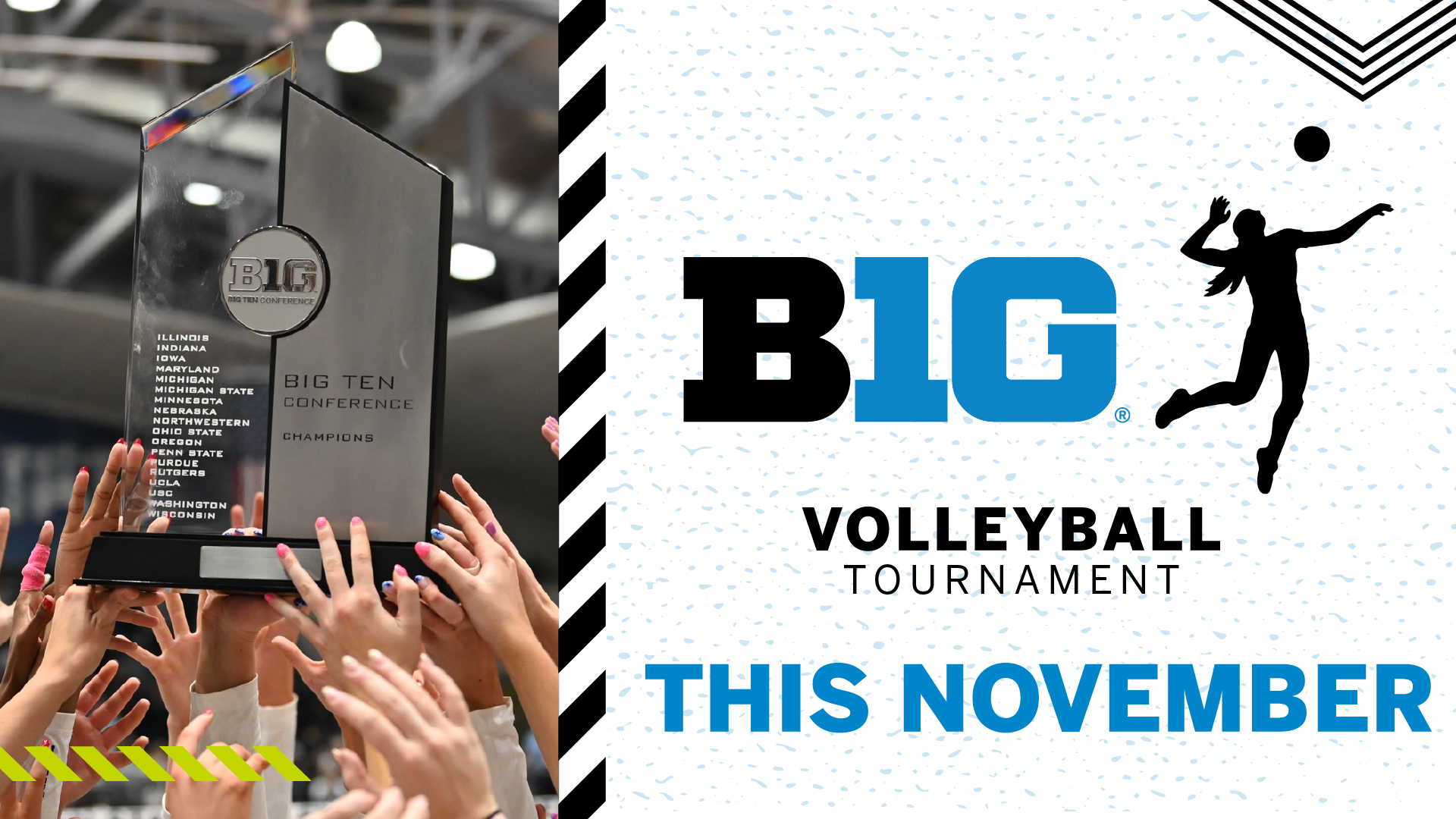
A seismic change has come to Big Ten volleyball with the launch of the league’s inaugural volleyball tournament.
Rather than a 20-match league schedule running through the final day before Selection Sunday, the Big Ten will feature a 17-match, round-robin conference schedule with the top 15 teams qualifying for the Big Ten Tournament held in Fishers, Ind., Nov. 20-25.
The top four seeds will receive a double bye to the quarterfinals on Nov. 22, the next four seeds will receive a single bye and the bottom six qualifiers will play in the opening round on Nov. 20. Quarterfinal winners will get a day off before the semifinals on Nov. 24 with the championship to follow on Nov. 25. Selection Sunday will take place on Nov. 29 this year, with the NCAA Tournament set to begin on Dec. 3.
“I’m really excited,” Nebraska coach Dani Busboom Kelly told Hail Varsity. “I think it’s going to prepare our team to have a different mindset going into the NCAA Tournament. It’s going to be hard to win the Big Ten tournament playing at least three games in a row, back to back to back. It’s something we’ve never done before, so I think it’ll be awesome, and I’m really looking forward to it. I think the timing’s great. We have a long break going into the NCAA Tournament, so I think it should help the league overall.”
The Huskers have won the Big Ten title three years in a row (sharing it with Penn State in 2024 and winning it outright in 2023 and 2025), and now they’ll have a new challenge to face to extend that streak.
The other coaches had plenty to say about the tournament at Big Ten Media Day in Chicago, with excitement the overriding theme.
Michigan State’s Kristin Kelsay and Northwestern’s Tim Nollan were overwhelmingly positive about the tournament and what it means for both the league and the sport as a whole.
“It’s the most elite conference in college volleyball,” Kelsay said. “So now to have this platform where we get to put all of these teams, 15 Big Ten teams in one place, from an attendance standpoint, from a quality-of-play standpoint, from a national television, having it nationally televised, we are excited. Even in our Big Ten head coaches call, we are ready, our team is ready, the Big Ten is ready, the country is ready for a Big Ten tournament.”
“I’m really excited for the tournament,” Nollan said. “I think it’s going to be an incredible TV event. I think it allows us to showcase the quality of the league, taking 15 teams, giving some byes to protect the top seeds so they’re not exhausted going into the NCAA Tournament. I like the timing of it before Thanksgiving, before the draw. I also like that it changed the regular season to a single round-robin. It’s a balanced and equitable schedule to rank out for the tournament seeding. To me it’s a win-win. I think the Big Ten did a good job of listening to the coaches and implementing it for this fall, and I think the nature and structure of it is going to be first class.”
For rebuilding teams like Iowa and Rutgers, the Big Ten Tournament provides a new goal as teams who are out of at-large consideration will still have something to play for late into the season.
“I was a big proponent for it ever since I came in the league,” Iowa’s Jim Barnes said. “I thought it would be a no-brainer as far as how exciting it would be. It would be another championship for these ladies to play for. I think the volleyball world is going to turn their eyes onto it. I was glad it finally went through. We had to talk some coaches into it. I think it’s going to be like, ‘Why didn’t we start this earlier?’ I think it’s exciting. It’s one of our senior goals here, that was definitely one of them, getting to that tournament and keep advancing so we can get in the NCAA Tournament.”
“The Big Ten Tournament’s really an important step in the future of this conference in volleyball,” Rutgers’ Caitlyn Schweihofer said. “I have friends who are coaches in the SEC, and when that was on their docket for the last season I know there was a lot of excitement around their tournament. But we got to use that as a foreshadowing to the success the Big Ten Tournament will bring and also learning some lessons about dos and don’ts to make it successful. So being a player that had played in a league that had a tournament, that was exciting to do as a player, and also as a coach at my previous two institutions that had conference tournaments.
“I love the ability that we have as this program grows to continue to, if we’re not NCAA eligible, to be able to be Big Ten Tournament eligible deep into the season. So getting to play for something into the postseason is really, really important as you’re building a program.”
USC head coach Brad Keller was a bit more balanced in his take, offering up pros and cons as he sees it.
“I don’t know what I don’t know about the tournament,” Keller said. “So the positive is the exposure piece, you’re playing your best ball, you’re playing against really good competition and maybe getting yourself prepared for the NCAA Tournament. The downside possibly, is you might be burning out your players if they have to play three or four matches, or whatever the schedule might look like. So you could have a rough season, barely make the tournament, but be a really big threat. But now you’re burning your kids out because you have to play three or four matches or whatever that schedule looks like. So that’s the only concern I have with it. But all everything else, I’m pretty excited about in general.”
Illinois head coach Chris Tamas remarked on the impact the shift from 20 league matches to 17 will have on the way teams need to assemble their nonconference slates and construct their calendars before expressing his own excitement about the round-robin format.
“Obviously, you’ve got to get there,” Tamas said. “I think it changes a little bit what I have to do with nonconference play. You’ve got to make sure you get your matches in because you’re losing three from conference. If you’re still working the RPI game and everything else, which we are, you have to make sure you’re filling the void in some noncon play. I see some teams are trying to add on at the end of the season or in the middle around the country.
“Like everything, change is just a little bit for the better. You get every team once. Everyone gets a fair shake more or less, and then you get a true champion in the tournament play. So I think it’s great. Really appreciate Commissioner [Tony] Petitti to go forth and help us do this. We’ve been talking about it for a long time. I think now with the addition of the four West Coast teams, it made a lot of sense to play everyone once. You can kind of maybe space that out a little bit more to alleviate some of the compression from travel. I think it’s a great thing. It’s going to be a great environment. You’re going to see some really, really competitive matches obviously throughout the year, but I think that tournament is going to be one of the best out there.”
Wisconsin head coach Kelly Sheffield said he had no interest in adding a match in the open window between the conference tournament and Selection Sunday, but Minnesota’s Keagan Cook took the opposite approach. The Golden Gophers will host High Point on Nov. 28.
“We like to do things a little differently in Minneapolis,” Cook said. “I think the idea is depending on where you finish if that Big Ten Tournament it’s a long time before you play another match, so making sure that the team stays in rhythm was the main point of that. Having a senior night that’s not a Big Ten match is something I wanted to explore, making sure that we celebrated our seniors in front of their home crowd appropriately. So that was probably two of the main reasons behind finding a match there to round out our nonconference schedule.”
As for the tournament and the round-robin schedule, Cook said he’s “open-minded.”
“Just the intensity, when you play somebody once and you know you have to wait a year to play them again, it’s an easy match to coach,” Cook said. “The athletes know what it means. You know what it means. The athletes and the coaches are going to respond to that. Then as far as the tournament’s concerned, you put these coaches and these players in a building with whatever sized trophy, I think you’re going to like what they do. We saw that from other conferences, but I think the Big Ten version of it is going be something special.”