




No. 1 Nebraska volleyball has a bit more nonconference business to take care of before diving into Big Ten play this weekend as the Huskers and Missouri will make up their suspended match on Wednesday.
The teams won’t get to play in front of 40,000 fans at Wrigley field, but they will compete in front of more than 10,000 at the Devaney Center instead. Senior Andi Jackson, who led the joint team impromptu a cappella rendition of “Since U Been Gone” after officials called off the first meeting, said she’s “super excited” about the opportunity to play the match, which will start over from 0-0.
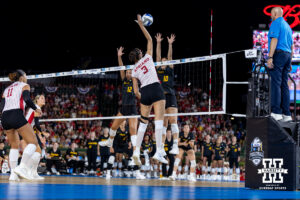
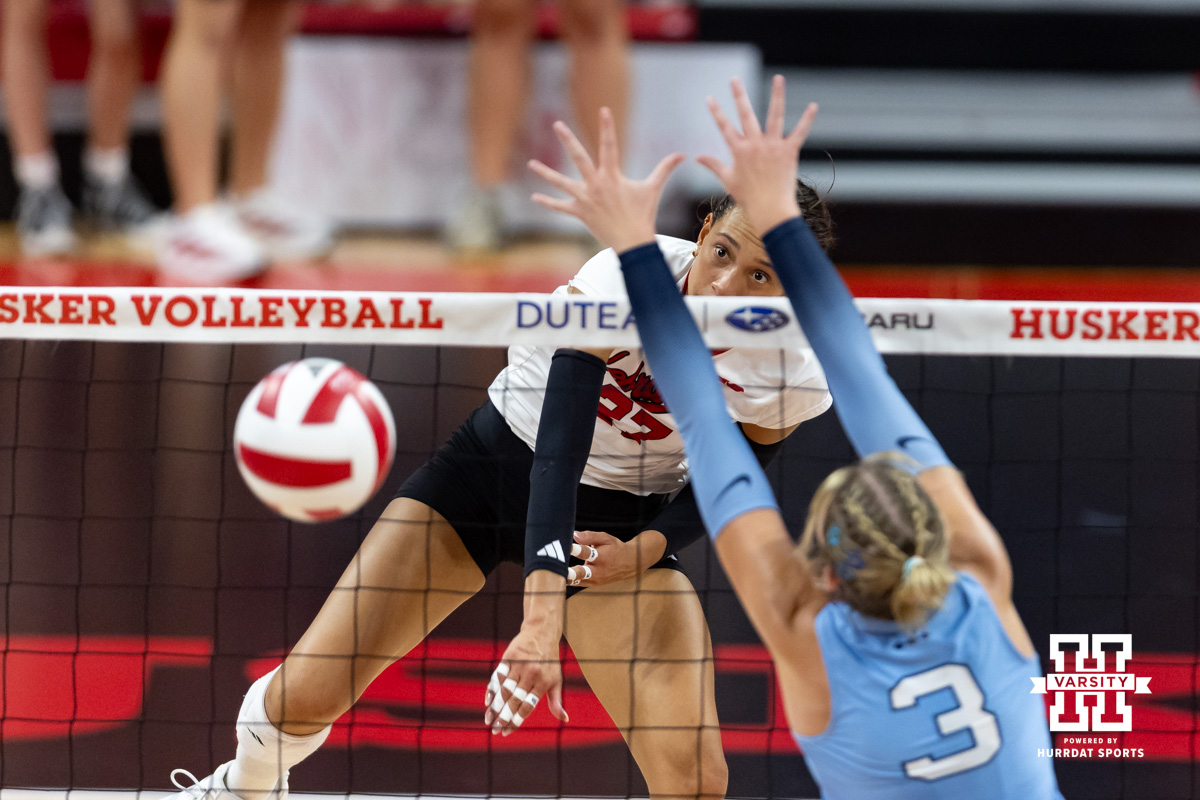
Virginia Adriano (3) spikes the ball for a kill against the Missouri Tigers during the Big Ten/SEC Challenge in Wrigley Field. Photo by John S. Peterson.
“I’m happy for them too,” Jackson said of the Tigers after Nebraska’s win over Creighton. “I think they’ll have a really, really good time here, and to get to play at the Bob in front of that many people, I think, will be super special for them. So it makes me really happy because I know that we obviously couldn’t do that at Wrigley, but I’m excited for their team to get to experience it.”
Nebraska deputy athletic director/senior woman administrator Kristen Brown worked with Missouri to find a time to reschedule the match.
“This was really the only week we could reschedule it,” Busboom Kelly said after Nebraska’s win over FGCU. “If it didn’t work this week, it probably wasn’t going to happen. The administration handled that, which was kind of nice, so it left us out of it.”
While Busboom Kelly didn’t have to worry about sorting out the logistics herself, rescheduling the match does disrupt what would have been a normal week of practice with four days between contests heading into Big Ten play.
“The bad thing about adding that match is we don’t get a tough training day; we’re going to have to play,” Busboom Kelly said. “But on the flip side, you learn a lot playing against opponents, and you get to adjust and practice some mental things that are tough to simulate in practice. I think it’s probably going to be good for this team to have that added match.”
The added match will be against a 7-4 Tigers team who is coming off five-set losses to Dayton and Toledo last week. Other notable results are a 3-1 win against Florida Gulf Coast and a 3-1 loss to Louisville, now ranked fourth in the latest AVCA Coaches Poll.
Paige Felder, a 6-foot-3 sophomore outside hitter, leads the attack at 2.76 kills per set on .229 hitting. However, Missouri’s lineup has been in constant flux this season as freshman middle blocker Eva Smith and senior libero Ainoah Cruz are the only Tigers who have played in and started all 11 matches this season. Beyond Felder, Missouri has five other players averaging between 1.90 and 2.5 kills per set as they’ve run a 6-2 offense recently with senior Sierra Dudley and freshman Piper Batie splitting setting duties.
This week, the Huskers will look to build on their 10-0 start, which they have accomplished in each of Busboom Kelly’s first two seasons at the helm. It’s the first time Nebraska has started 10-0 in consecutive seasons since doing so in four straight from 2005 to 2008.
A big part of that start has been the team’s emphasis on more aggressive serving, which has paid dividends early in the season. Nebraska is 19th nationally in aces per set at 2.12, up from 1.32 a season ago. The uptick in aces has also come with only a slight increase in error rate (from 8.2% to 10.1%) and carries an improved ace-to-error ratio (0.864 versus 0.667 last year).
“We’ve been putting a lot of work in on our serving, and we dread it a little bit at practice, just because it’s slow,” Harper Murray said after Nebraska’s win over North Carolina, which featured a Devaney Center record 13 aces. “We want to play six-on-six, we want to do high-level, high-energy drills, but I think it’s games like this that really show the training part of practice is so important, and it translates in games.

Laney Choboy serves the ball against the Baylor Bears. Photo by John S. Peterson.
“Dani’s been putting a lot of emphasis on serving, and honestly, I think throughout the whole season it’s been really good, and I feel like it’s been improved a lot since last year. Obviously, when the other team is out of system and they’re not passing, it makes our job a lot easier.”
The improvement has been across the board as well — all six of Nebraska’s primary servers have increased their aces average from a season ago, none more so than Laney Choboy. The senior defensive specialist wasn’t even a full-time server to start the season but has become a big weapon for the Huskers as she leads the team with 14 aces and only seven errors. Choboy tallied just 12 aces compared to 26 errors all last season.
“She’s just mixing the depth, so she’s dropping it short, the way she’s serving it that’s tailing off, and then her floats, some of them teams have let go — they think they’re out — and those drop in,” Busboom Kelly said on the Huskers Radio Network Tuesday. “She hides if she’s serving short or deep, and that makes it very hard for the opponents to judge.”
Beyond just the aces, Nebraska’s serving has kept teams out of system at a significant rate, which has played a big part in Nebraska leading the nation in opponent hitting percentage at .087.
Nebraska will look to carry that serving momentum into Wednesday’s match. First serve between the Huskers and Tigers is set for 6 p.m. CT on Big Ten Network with Larry Punteney and John Cook on the call.
Nebraska will then open Big Ten play on Friday at the Devaney Center against Rutgers before returning to John Cook Arena on Saturday to close out a nine-match home stand against Ohio State.
Busboom Kelly’s goal for this week is to see a lower error rate from her team. The Creighton and North Carolina matches featured the highest attack error totals of the season, with the pin group particularly struggling — though Murray and Teraya Sigler ended the weekend on a high note against FGCU.
“It’s really annoying, I think, for everybody — coaches, players and fans — when it’s pass, set, error,” Busboom Kelly said. “Let’s keep the ball in the court a little bit more. That doesn’t mean we’re not aggressive, but low error is usually a good thing.”