




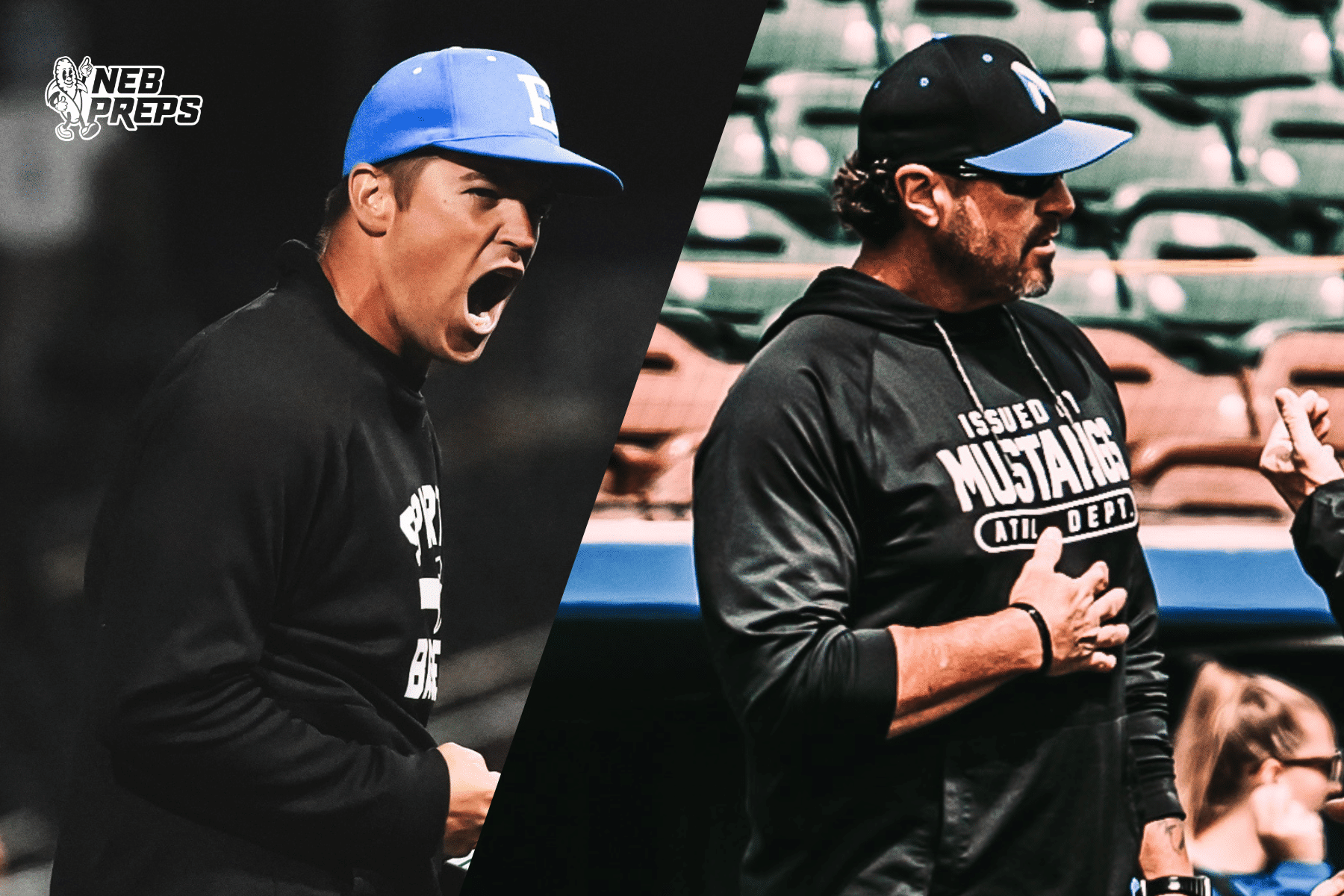
Millard North baseball has found a process that works. Lincoln East baseball established its own standard nearly a decade ago and has continued to live up to it. On Saturday, the two teams will face off for the ultimate prize, with coaches that have walked parallel paths to success leading the way.
In year three of the Bob Hlavac era, the Mustangs will play in the Class A Baseball State Championship, their second Class A final appearance in as many years.
“The process never ends,” Hlavac said after the Mustangs defeated rival Millard South 4-2 in Wednesday’s semifinals. “It’s being on time. It’s getting your work done in the classroom. It’s being good people outside of the four walls of school.”
In the other dugout will be reigning champion Lincoln East. The Spartans, under Mycahl Lanik, have won two of the previous three state championships and will make their fourth straight state final appearance.
For East, keeping the main thing the main thing is what has resulted in sustained success.
“No reason to focus on what happens on May 22 in the weight room on Sept. 13,” Lanik said. “Just focus on your nutrition, your sleep, and getting a good workout in. When we go play a doubleheader in North Platte on April 9, that’s what matters. How we compete, how we handle adversity, how we treat our teammates — keep what’s right in front of you as the priority and things tend to work out OK.”
Sustainable Winning
Building a sustainable winning program clearly takes talent; both Millard North and Lincoln East have talented players. They both benefited from adding transfers that have helped them win at a high rate, and quickly.
Winning at a consistently high level takes more than one or even two players, though.
“You have to have good players,” Hlavac said. “We were fortunate. We had some kids transfer in. Those guys came in and were very well accepted by everybody else at a quick rate.”
Collecting the best talent or a transfer here and there isn’t the be-all and end-all. You still need to develop that talent, which Hlavac says can’t be done just in a spring season.
“It’s hard to develop in the spring,” he said. “We hit from the middle of October two days a week, and that’s about all we do, to be honest. I know there’s a lot of programs that do more, but you get seven guys to work with at a time. You just don’t have a lot of time, then you get tryouts done and you’ve got two weeks to go play your first game.”
That lack of time is why Hlavac believes heavily in the importance of the weight room.
“A lot of our stuff starts in the weight room,” Hlavac said. “And we’re very fortunate. We’ve got a great strength and conditioning guy that is actually a Millard West graduate, Jake Kastaitis.”
Kastaitis, a strength coach in the Oakland Athletics organization and owner of 402 Performance, has worked with Hlavac since his five seasons as an assistant coach at Millard West.
“When he gets done with his season, he comes up and we work out four days a week and it’s 6 in the morning,” Hlavac said. “A lot of our culture and our standards are set there.”
The offseason is time to develop that winning culture.
Assigning homework on baseball IQ is one way Hlavac tries to make up for the time the Mustangs don’t have to work with their players in the fall and the winter as much as they would like.
It takes the ultimate buy-in from the top down. The standards need to be set early in the process; Hlavac and Lanik have done that.
“Kids in the first year bought in, and then they saw the success,” Hlavac said. “So then the next year, it became easier because they knew what to expect. Last year’s group was just full of leaders, and they kind of just took it and ran with it, to be honest. This year, we struggled, even in the weight room early, because we didn’t have guys to hold other people accountable. They were so used to the previous guys doing it all.”
The process needed fine-tuning.
Hlavac needed to show the team a different voice, a leader that they could learn from other than himself.
Insert a 10-week leadership training on Michael Jordan and “The Last Dance” documentary.
“We made them watch it,” Hlavac said. “Every week they watched and then they brought a paragraph each week on how the competitiveness and the accountability that MJ put on his teammates and himself. We tried to instill that type of leadership, accountability, and standard that he wanted to perform and lead by.”
Every day wins matter when you are building a program. Hlavac and his staff took what his team learned from “The Last Dance” to build towards the next step.
“We talk about wins every day; they have to come up with three wins every day, and this is mostly in the offseason,” Hlavac said. “We can’t get away from it in season. You’ve got to make your bed, you’ve got to eat breakfast and then you’ve got to do something nice for somebody else, throughout that day, before you get to the weight room.”
From holding the door at the grocery store for a stranger to saying hello with a smile to an elderly person, it is all a part of the process.
But Hlavac wanted more from his program.
“We kind of had to get away from that easy stuff,” he said. “A lot of your well, you know, tell a teacher hi, ask a teacher how their day’s going, are great, but it’s not out of the way. A clerk at a gas station, ask him how his day is going. Something like that is more impactful. So we’ve tried to build the level of the standard that we want to be at.”
For Lincoln East, a program that has been one of the top baseball programs in the state over the past the decade, winning has been more of a constant.
At this point, year nine for Lanik at the helm at East, the standard is set.
“The players deserve the credit for the run we’ve been on, six straight semi-finals, four straight finals appearances,” Lanik said. “That stuff doesn’t happen without amazing players, but more important than their talent is their desire to be great. Their willingness to want to be held accountable and coached hard, that isn’t common in 2026.
“They come from great families and they know at East, the spotlight isn’t always going to be on them. Some days it’s their job to hit the double, some days it’s their job to get hit by a pitch, or warm up the starting pitcher, or cheer on their teammates. When they all embrace that, it makes it a really fun program to be a part of.”
Learning From Winners
There are parallels between the two leaders of their respective programs.
Lanik, an assistant coach at Creighton Prep for longtime coach Pat Mooney for five seasons (2012-2017), helped the Junior Jays win three state titles (2012, 2016, 2017).
“Mooney is one of my best friends,” Lanik said. “He gave me so much freedom as a young coach. He walked me through scenarios, taught me how to keep things light and get the best out of kids. Greg Geary at Millard South has treated me so well. That program is so amazing.
“I’m far from a smart guy, so I try to learn and take things from so many different good high school and college programs and coaches. Guys like Will Bolt and Rob Childress at Nebraska, Tim Corbin (Vanderbilt), John Savage (UCLA), or Kirby Wells at Grand Island or Anthony Dunn at Elkhorn North, I try to steal little things and learn from all of them.”
Building a sustainable winner is something both coaches have learned from winning programs. Hlavac did so in his five seasons as an assistant at Millard West, where he helped the Wildcats win two state titles (2019, 2022) and earn one runner-up finish (2021).
“I learned a lot from Coach (Steve) Frey,” Hlavac said. “I give him a ton of credit. He gave me a lot of leniency there and said, ‘Hey, go do what you want to do.’ Ultimately, it was his program and he always made the final decisions, but he was very receptive to some ideas, and I learned a ton from Coach Frey.”
Finding and developing really good players to coach is one thing; being all-in in the weight room, having players that care about winning and the team more than stats and roles is another.
More important than all of those things for Lanik and Hlavac to sustain winning at a high level in 2026 is building a deep and incredible assistant coaching staff. Perhaps one day those assistants can emulate Hlavac and Lanik with a program of their own.