




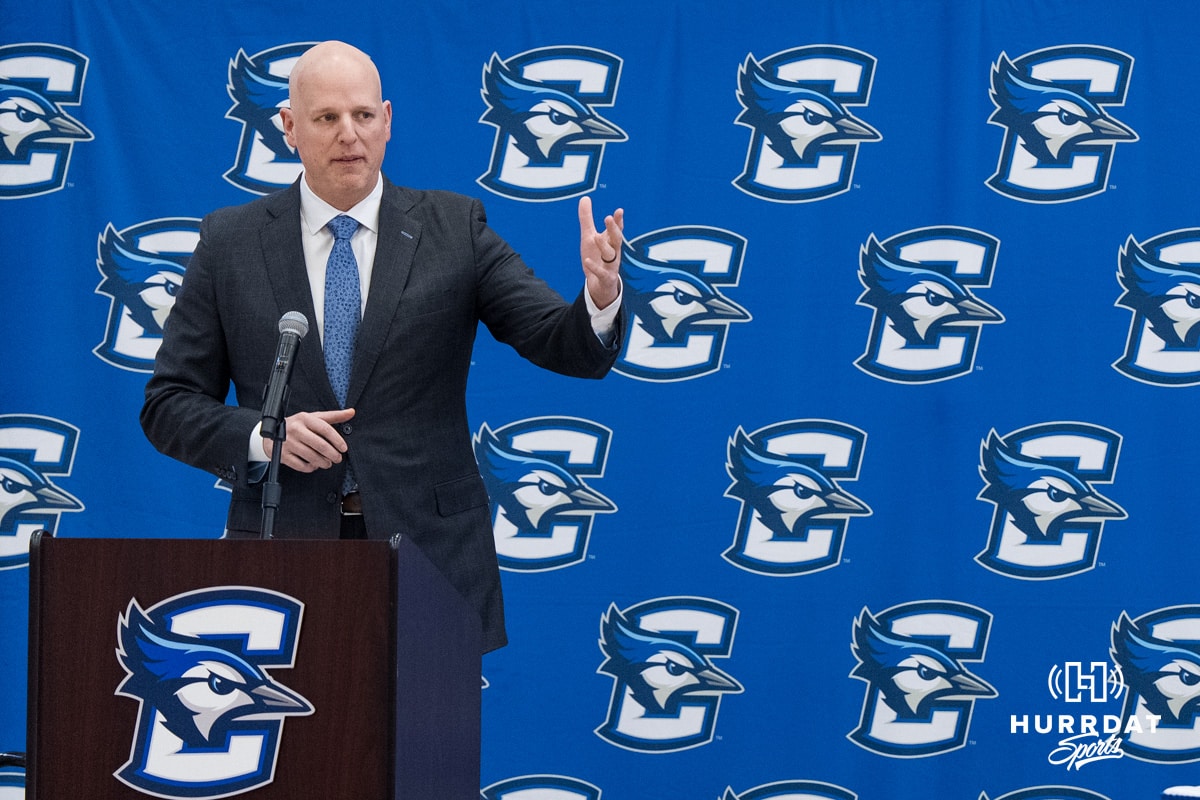
At his introductory press conference, Alan Huss laid out his vision for Creighton men’s basketball moving forward, and he’s backed up those words with his first recruiting class thus far.
Huss and his staff have landed four transfers, retained one high school commit, added a junior college commit and recently dipped back into the high school ranks to boost the roster count to 13. With only two roster spots still open, the 2026-27 picture has come into focus, and it looks a lot like the blueprint Huss laid out.
First off, Huss made it clear that the brand Greg McDermott built during his two-plus decades in Omaha isn’t going anywhere.
“Let it fly has been a huge part of why we have been able to develop our brand as one of the premier offenses in college basketball,” Huss said. “There’s no reason to fix what’s not broken. We will continue to let it fly, we’ll continue to recruit talented student athletes that share the ball, that are unselfish and that want to play at that tempo. That’s not going to change.”
It’s worth noting that while Huss said he took the Creighton blueprint with him to High Point, his two Panthers teams didn’t quite stack up to the vintage Bluejay squads in terms of 3-point accuracy and volume. Both High Point teams under Huss attempted 39.4% of their field goal attempts from 3, which is slightly above average (117th in 2023-24, 168th in 2024-25). Their assist rates ranked 350th and 321st.
This year’s decidedly underwhelming Creighton team ranked 23rd in 3-point rate and 52nd in assist rate. The 2023-24 Bluejays ranked eighth and 41st in those two categories.
While Huss took much of the way McDermott ran things with him to High Point, he didn’t have a roster equipped to have success playing the same way. At Creighton, it appears he’s made sure that won’t be the case.
First off, the pieces he retained — Jackson McAndrew, Austin Swartz, Isaac Traudt and Hudson Greer in particular — give Creighton a strong shooting foundation. Furthermore, he landed one of the most prolific spot-up shooters in the portal in South Florida transfer Wes Enis. The 6-foot-2 guard averaged 16.4 points and shot 35.2% on 9.5 3-point attempts per game in his lone season with the Bulls. He began his career at the Division II level, and across his three collegiate seasons he’s knocked down 257 3-pointers at a 37.3% clip.
While not as prolific as Enis, San Diego State transfer B.J. Davis is a capable 3-point shooter as well, connecting at a 37.4% rate last season. TCU transfer Kayden “Bugg” Edwards shot 43.5% from 3 in limited action as a freshman.
Huss certainly loaded up on 3-point shooters. However, who is going to get those guys the ball? Who is going to trigger that chain reaction that generates quality 3-point looks? The answer appears to be multi-faceted.
Davis doesn’t profile as a prototypical point guard, having averaged just 1.5 assists during his first three seasons at San Diego State, including a career-high 2.2 this past season. However, the Aztecs had five players average between 2.2 and 3.0 assists — a true playmaking by committee situation. Creighton believes in Davis’ ability to generate paint touches and operate out of ball screens, and the staff is betting that a different system will unlock more of his playmaking ability.
The other important factor to note here is that Huss retained the commitment from 2026 four-star point guard Katrelle Harmon, who finished third in the EYBL Scholastic League in assists per game as a senior after leading the league as a junior. The staff believes in his playmaking ability and he will have every opportunity to earn a meaningful role as a true freshman. We’ll likely see some lineups where Harmon shares the floor with two of Enis, Swartz and Davis in three-guard looks.
Huss also spoke about his vision for the other end of the floor, where fans can expect to see a notable shift.
“Defensively, we’ll stay with what we do,” Huss said. “We’re going to play man-to-man defense, maybe get a little bit more disruptive. I’d like to take full credit for that, but that’s something that Coach Mac and I have been talking about here for weeks. I think we’re going to move that direction. But I think you’re going to see a defense that gets maybe slightly more disruptive.”
Disruption wasn’t a hallmark of Huss’ High Point teams (355th and 261st in opponent turnover rate), and fans know how much of an emphasis McDermott put on playing without fouling. That worked with Ryan Kalkbrenner patrolling the paint, but last season was an unmitigated disaster on the defensive end — largely because of the personnel. This portal cycle, the staff put a clear emphasis on addressing that.
First off, it’s hard to extend pressure on the perimeter without rim protection on the back end, something Creighton definitively lacked a season ago. To address that, Huss and staff landed three centers — one from the portal, one from junior college and one from the high school ranks — whose lists of strengths all start with shot-blocking. Former Providence Friar Oswin Erhunmwunse (6-foot-10, 235 pounds) will start at the five while Wesly Rosa (7-foot-2) and Trevon Carter-Givens (6-foot-11, 190 pounds) will compete for backup minutes. Creighton can still use Jasen Green at the five in favorable situations, but the additions give Huss the ability to play with a true rim protector for the entire 40 minutes if he so desires.
The disruption part is also where the Davis addition looms large. If there’s one thing you must do to play for Brian Dutcher at San Diego State it’s getting after it on defense, and Davis spent three seasons with the Aztecs. He’s quick and physical at the point of attack, which is something Creighton simply didn’t have a year ago. Josh Dix proved to be a far more affective on-ball defender than I think anybody expected, but nearly everybody who played around him on the perimeter struggled to keep the ball in front of them.
The jump shot is certainly Enis’ calling card but buried in his resume is a conference defensive player of the year award at the Division II level. While I don’t believe that translated to him being an all-conference defender at South Florida, it does indicate a certain level of aptitude and effort on defense, two things Creighton largely lacked a year ago. Put Davis and Enis out there with Green and Erhunmwunse behind them and I think Creighton has the pieces to play the way Huss is envisioning.
The additions and Huss’ own words give us some insight into how Creighton will play in 2026-27. How successful will the Jays be playing that way? That question remains.
Bart Torvik’s T-Rank projections have the current Creighton roster slotted 36th overall and fifth in the Big East (behind UConn, Villanova, Marquette and St. John’s). Torvik projects Enis (15.1 points per game), Green (13.4), McAndrew (13.3) and Erhunmwunse (11.5) as Creighton’s top contributors. His algorithm is notably lower on Davis (7.0 points and 2.3 assists per game), Greer (3.7 points per game) and Harmon (4% minute share).
Evan Miyakawa of EvanMiya.com released his Creighton outlook last month. At the time, he projected Creighton’s roster to slot into the 28-34 range (24-28 on offense and 22-36 on defense) with Enis (5.75 Bayesian Performance Rating), Erhunmwunse (4.7), Green (3.73) and Davis (3.63) as the team’s top impact players. In his projections, McAndrew slots in eighth (1.47), narrowly ahead of Greer (1.32) and slightly behind Harmon (1.53), but that’s based on his general method for players coming off season-ending injuries more than anything specific to McAndrew.
Both outlets are high on Enis and Erhunmwunse, but will either one be a first-team selection in the Big East? Coming off injury-impacted seasons, can McAndrew and/or Greer break out and raise the team’s ceiling?
This roster projects to be an NCAA Tournament qualifier (especially with the expanded field), but on paper, contending for a conference title or making a deep postseason run would be considered overachieving in year one under Huss.